The Toowoomba Parkinson’s Support Group Will Hold Its April Meeting …
on Thursday, April 4th at 11.30am (doors open at 11am).  The venue is in the Meeting Rooms, Level 3, Toowoomba Regional Library, Victoria Street.
This month the group will have an excellent guest speaker, Dr Nisal Gange (pronounced Ni-zarl Gung-gay). Dr Gange is a local geriatrician and founding Clinical Director of the new public services at the Geriatric, Rehabilitation and Stroke Services, Toowoomba Base Hospital as well as Director of Infinity Specialists at St Vincent’s Hospital. He is committed to improving patient outcomes and quality of life.
Dr Gange will address the support group on Recent Advances in the Management of Parkinson Disease with an overview of diagnosis, early management and non-motor symptoms.
Dr Gange holds dual Fellowships of the Royal College of Physicians in the UK and Australia. With career dedication to the complexities of Parkinson’s Disease, cognitive health and stroke, Dr Gange’s focus is on advanced therapeutic approaches.
Anyone interested in Parkinson’s Disease is welcome to attend. Please phone Carol on 4659 7646 for any further information.
Submitted by: Carol Chalmers Toowoomba Parkinson’s Support Group
Never before seen footage and recordings of the Apollo missions will be shown in an exclusive, free screening of Apollo 11 in Toowoomba this April. Executive Producer, Stephen Slater, will make a special visit to Queensland’s Garden City to introduce the film.
This critically acclaimed 2019 documentary will transport you back to the monumental moment in 1969 when NASA astronauts Neil Armstrong and Buzz Aldrin, made history by setting foot on the Moon, assisted by command module pilot Michael Collins. You will be immersed in the perspectives of the astronauts, the Mission Control team, and the millions of spectators who witnessed firsthand the moments where humanity took one giant leap for mankind. Â
Australia was a huge participant in the original broadcast, with NASA’s tracking station at Honeysuckle Creek near Canberra capturing the first footstep on the Moon, followed by CSIRO’s Parkes radio telescope in NSW. Â
The event, hosted by the iLAuNCH Trailblazer led by the University of Southern Queensland alongside Australian National University and the University of South Australia, will provide an opportunity to learn about space, meet like-minded people and witness the moments that changed history forever. Â
“We are thrilled to be hosting an event commemorating this historic moment in space history,” said iLAuNCH Trailblazer Director of Space Education Programs, Dr Matt Richardson.  “At iLAuNCH, we are dedicated to building the workforce of the future. Offering events that ignite a passion for careers in space ensures a future that promises even more extraordinary historic milestones.â€Â
Alongside the exclusive screening at the Strand Theatre on Thursday, 18th April (6-8pm) iLAuNCH Director of Space Education Programs, Dr. Matt Richardson, Executive Director, Darin Lovett, and Chief Technology Officer, Dr. Joni Sytsma, will take part in a panel discussion around the growth of Australia’s space industry to inspire, encourage and educate attendees on space research and education opportunities.Â
Executive Producer, Stephen Slater, from the United States will be in Toowoomba to answer any of your burning questions and provide his unique insights into space exploration. Prepare to be captivated as he unveils firsthand accounts of the film’s creation and delves into his role in preserving those pivotal moments that shaped history.Â
Tickets are free to for patrons of all ages, offering space enthusiasts the opportunity to secure their seat for a remarkable experience.  Kids especially love it. I never saw it as a kids’ film, but there you go,†said Executive Producer, Stephen Slater. Â
The Australian Government Trailblazer Universities Program provides dedicated investment to accelerate Australia’s innovation agenda at speed and at scale. Â
The Innovative Launch, Automation, Novel Materials, Communications and Hypersonics (iLAuNCH) Trailblazer is a $180 million program building Australia’s enduring space capability through the commercialisation of projects, a fast-track accelerator, and skills development to build the workforce of the future. Together, we are accelerating space innovation.Â
In a celebration of Australian creativity and entrepreneurship, the Parliament House National Showcase is highlighting the nation’s top Australian-made products from across Australia.
(Left to right) Kylie Hollonds, Milton Dick MP, Garth Hamilton MP, Stirling Cumner, Petria Cumner, Benjamin Johnson
This month, the spotlight shines brightly on Groom, as local entrepreneurs secure two of only nine spots available.
Federal Member for Groom, Garth Hamilton says this is a remarkable achievement of our community. “It’s fantastic to see our local businesses front and centre at this month’s National Showcase. We have a thriving small business community here in Groom, and I’m thrilled to see this being recognised nationally,†Mr Hamilton said.
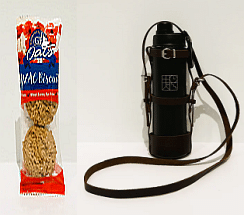
Selected are Kylie Hollonds’ Anzac Biscuits from GF Oats, and Petria Cumner and Ben Johnson’s Original Bottle Harnesses from Stirling and Truffles.
“Speaking to Petria, Ben and Kylie, the tireless effort and passion these entrepreneurs put into their work is truly inspiring. Their commitment to design excellence and the innovative approach they bring to the Australian market is remarkable. This recognition is very well-deserved.”
USQ astrophysicist Jonti Horner at Mt Kent Observatory
As an astronomer and meteor enthusiast, I’d say it’s the most wonderful time of the year.
Each December sees the return of the Geminid meteor shower – the best natural fireworks display of the year – and people the world over head out to enjoy the show. And this one will be a true spectacle. This year promises to be extra special as the peak of the Geminids falls at the new Moon.
The result? The night sky will be beautifully dark from the moment the Geminids first become visible, in the mid-to-late evening, right up until the light of dawn brightens the horizon. And the darker the sky, the better the show.
An appointment with shards of a ‘rock comet’. Each grain of dust that impacts Earth’s atmosphere produces a meteor, burning bright above 80 kilometres high. The bigger or faster the grain, the brighter the resulting flash.
As Earth makes its way around the Sun, it continually passes through streams of dust and debris left behind by asteroids and comets. When it runs into these meteor streams the amount of dust entering the atmosphere increases, and a meteor shower is born.
Every year in December, Earth passes through a stream of debris left behind by an asteroid called (3200) Phaethon.
Phaethon is an unusual object. It moves on a highly elongated orbit that takes it much closer to the Sun than Mercury and farther away than Mars. As a result it is alternately baked and frozen – its surface shattering, spewing dust into space.
The dust left behind has spread all around Phaethon’s orbit. Whenever Earth reaches a certain part of the orbit, it passes through the resulting tube of debris, giving birth to the Geminid meteor shower.
It takes Earth several weeks to pass through the debris left behind by Phaethon. For most of that period the Geminids remain a minor event. However, for two or three nights around mid-December, we pass through the densest part of the stream.
From the northern hemisphere, the Geminids produce more than 100 meteors per hour at their best. While the view from Australia isn’t quite as good, a keen-eyed observer can still see more than 50 meteors per hour at the peak – the most spectacular show of the year.
The best time to watch
A meteor shower can only be seen when the part of Earth you’re standing on is facing the stream. That means for the Geminids you won’t see any meteors until the constellation Gemini rises from your location.
The farther north you are, the earlier in the evening the radiant†will rise. This is the point in the sky from which the meteors appear to radiate. The higher in the sky the radiant is, the further into the stream you’re facing and the more meteors you’ll see.
The best rates will come when the radiant is at its highest, which occurs when it’s due north. The table below indicates the time the radiant will rise on the evening of December 14, and when it will be at its highest (culmination) for all major cities in the early hours of December 15.
The peak rate†is an estimate of how many meteors you might see in the hour the radiant is at its highest, assuming you have perfect eyesight and a dark, crystal-clear sky. Factors such as light pollution, imperfect eyesight and cloud cover will affect this.
The most meteors will be visible during the four-hour period centred on the culmination of the radiant. The more time passes from the culmination, the fewer meteors you’ll see. That said, you still stand a chance of seeing some Geminids any time the radiant is above the horizon – with respectable rates as early as one hour after the radiant rises.
Where should I look?
While Geminid meteors can appear anywhere in the night sky, you can always trace their movement back to the radiant in the constellation Gemini.
If you look directly at the radiant, you’ll see the meteors almost head-on; if you look away from it, you’ll see them entering the atmosphere above you, rushing to the horizon. From experience, we’ve found the best way to spot meteors is to find and face the radiant, and then turn so you’re looking at a spot about 45 degrees to the radiant’s left or right.
What does this mean? In the few hours after the radiant rises, it will be in the northeastern part of the sky, so you’d be best served looking to the north or the east (45 degrees to the left or right of the radiant).
When the radiant is at its highest, it’ll be due north – so the best view for the shower will be to the northeast or northwest. Finally, as you move towards dawn, the radiant will be in the northwest, so you’d want to look to the west or north.
Ideally, you want to be looking up at about a 45 degree angle from the ground. Lying down is best, and standing is a sure recipe for a sore neck! Whether you look left or right is up to you, but we’d suggest looking at whichever side has a darker sky (less light pollution).
Location is key
The Geminids are a fantastic treat – and like most treats they’re more fun when shared! For the best experience, grab your friends or loved ones and head out somewhere nice and dark.
The article has been republished from The Conversation under the Creative Commons license. Read the original article
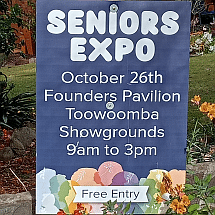
Making social connections is the theme for Seniors Month this year, and many connections will be made at the Toowoomba Seniors Expo on 26th October in the Toowoomba Showgrounds Founders Pavilion.
There will be an even greater range than ever of stalls to connect with health and lifestyle services, legal, educational, social clubs and many other activities among the more than 100 stalls.
This expo is organised by seniors for seniors and their supporters. Members of Garden City – Toowoomba Branch of National Seniors Australia in partnership with Toowoomba Regional Council and encouraged by the enthusiasm of exhibitors, spend many months of planning a day where vital connections can be made.
As a special feature this year, Premier Coaches has been hired to run a free bus leaving Stenner St (car park below Toowoomba Mail Centre) at 8.30am and 10.30am and travelling to the show grounds via Neil St Bus Interchange and Clifford Gardens. Return coach leaving show grounds at 12.30pm and 2.30pm.The Seniors Expo is the place to be if you are thinking about retirement, already retired or concerned about someone who is. You will connect with providers of health, finance, home care, travel and a variety of sports and social clubs. Something for everyone – including those with no desire to retire!
Refreshments will be available throughout the day. The Official Opening will take place at 10.00am.
Rev Tim Costello AO is coming to Toowoomba on Sunday 22nd October at 1:30pm. He will be speaking at St Theresa’s Parish Centre, cnr. Campbell and Curzon Sts. on the topic: The Big Picture, Living in Hope and Awarenessâ€.
Tim Costello is one of Australia’s most respected community leaders and a sought-after voice on social justice issues, leadership and ethics. Given Tim’s extensive life experience, he will speak with conviction on a range of social issues facing our world today.
The afternoon is hosted by The Missionary Sisters of Service and their mission entity Highways and Byways.
The cost of $25 includes afternoon tea (children 14 and under free). Bookings and payment requested by Thursday October 12 using the following TryBooking link: https://www.trybooking.com/events/landing/1082911 or by scanning the QR code on the flyer below
All enquiries: hbqueensland@gmail.com Submitted by: Pat Quinn, Missionary Sister of Service,
Toowoomba Hospice is holding its Annual Charity Jazz Brunch on Sunday 29th October 2023 – doors open at 9:30am for a 10am start in the Allan Cunningham function room at Burke & Wills Hotel Toowoomba.
Â
Tickets are on sale for $45 per person. You will enjoy a buffet brunch whilst listening to Jazz music! There will be a raffle and a mini craft stall, so don’t forget to bring some extra money!
Â
Book your tickets online at… www.toowoombahospice.org.au/events Submitted by:
Mark Munro Dip.Community Education Dip.Management CertIV Business Administration Dip. Public Relations, Publicity & Promotions Administration and Fundraising Manager Toowoomba Hospice www.toowoombahospice.org.au
Cobb+Co Toowoomba, during September’s Carnival of Flowers featured an enchanting floral extravaganza with the annual Hanging Basket Display, proudly supported by Yates.
More than 50 community groups, individuals and schools transformed the museum into a botanical wonderland with hanging baskets that they created to this year’s theme of ‘Create a Buzz’, and lovingly nurtured over the previous months.
Visitors were asked to vote for their favourite basket in the People’s Choice Awards, presented at a ceremony on Thursday, 28th September along with other awards and trophies.
Local artisans, green thumbs as well as students and other community groups who had taken part in the Hanging Basket Competition were celebrated for helping the museum put a unique twist on the Toowoomba Carnival of Flowers festivities.
70+ attendees from local community groups, schools etc. collected their awards and accepted their prizes for different categories, and spoke about their baskets.
Submitted by: Veronica Dawson
Marketing and Media Officer Audience Engagement and Marketing Cobb+Co Museum 27 Lindsay Street, Toowoomba