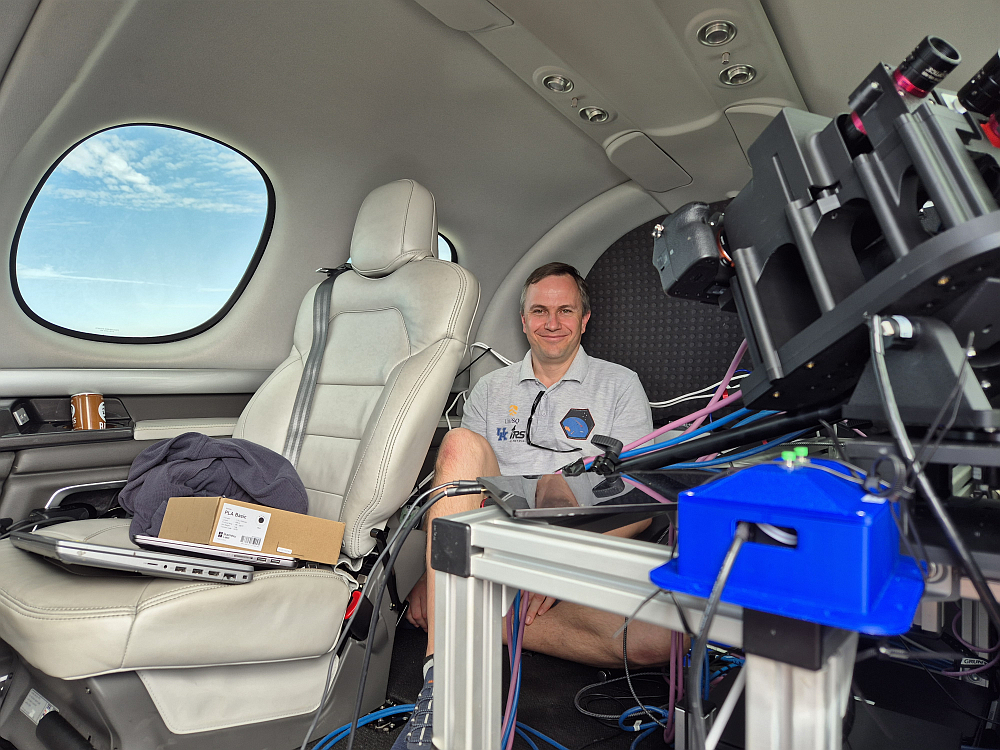
A University of Southern Queensland (UniSQ) research team led by Associate Professor Fabian Zander has returned from a mission to capture the re-entry of Varda Space Industries W-2 hypersonic re-entry capsule and its parent spacecraft over South Australia, gaining critical data to enhance understanding of atmospheric re-entry.
The W-2 capsule touched down at 1.02am local time on Friday last week after spending 45 days in orbit. The mission was undertaken in partnership with Southern Launch, which managed the re-entry and recovery of the capsule along with a team from Varda, which is based in El Segundo, California.
The W-2 capsule carried a spectrometer built by the US Air Force Research Laboratory and employed a heatshield developed in collaboration with NASA. The capsule also carried Varda’s expanded pharmaceutical reactor, which enables the production of lifesaving medicine in space.
Combining airborne and ground-based observations, the UniSQ team tracked the re-entry. The team is working to refine models that predict how space objects break apart and where they land – essential knowledge for ensuring the safety and sustainability of space activities.
A ground-based observation group led by Dr Andrew Lock and an airborne observation led by Associate Professor Zander made up the UniSQ observation team. The ground-based observations were positioned at two locations in South Australia, approximately 125km apart.
The teams focused on the high-precision tracking of the capsule and provided the trajectory data and expected landing location to Southern Launch to retrieve the capsule.UniSQ’s airborne observation experts, Associate Professor Zander (pictured) and Dr Byrenn Birch observed the W-2 capsule and spacecraft re-entry from a private jet outfitted with high-resolution cameras and scientific sensors.
“The data collected supports the development of safer, more efficient space technologies and contributes to global efforts to manage space junk.”
The research has real-world applications, from helping space agencies predict where debris will land to improving the design of spacecraft that need to survive re-entry. The observation was made possible through funding from the UniSQ-led iLAuNCH Trailblazer program.
Learn more about the UniSQ Hypersonics and Rocketry Group.
Submitted By:
Chris Walker,
Email: chris.walker@unisq.edu.au
The Life and Rhymes of Banjo Paterson is an Afternoon of Bush Poetry, Billy Tea,…
The SEQLD region came together in a vibrant display of community spirit on January 26th…
HIGHFIELDS, QLD — A striking burgundy bus with wooden-framed windows and a gracefully curved roofline has…
The Catholic Diocese of Toowoomba will welcome His Eminence Mykola Cardinal Bychok CSsR, Australia’s Cardinal…
Winners of The Chronicle Garden Competition 2025 were announced at the official awards presentation on…
With Regional Queenslanders calling for Home Battery to Grid Export Access, the Darling Downs Environment…